

Quick answer
How does local SEO work for a WooCommerce store selling custom products?
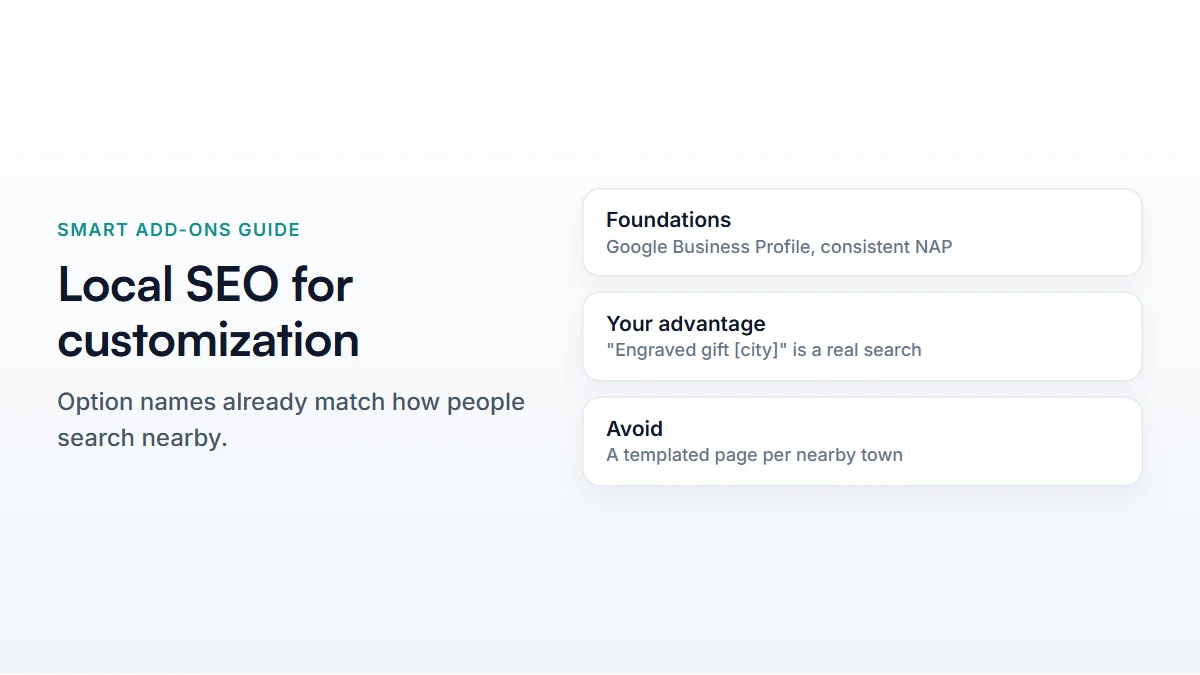
The same foundations as any local business — a complete Google Business Profile, consistent name/address/phone across the web, and local landing pages — plus one thing custom-product stores have that off-the-shelf retailers don't: option names and use cases that naturally match how nearby customers actually search, like "engraved gifts [city]" or "custom cakes near me."
Local SEO for WooCommerce stores selling custom products sits at an odd intersection: WooCommerce is built for stores that could ship anywhere, while local SEO is built for businesses tied to a place. Most local SEO advice assumes a physical shop or service area and doesn’t address what a store selling online but fulfilled or picked up locally should actually do. Here’s what applies, and what a custom-product store specifically has working in its favour.
Local SEO for WooCommerce stores selling custom products: does it apply?
Local SEO matters if any of these are true: you offer local pickup or delivery, you have a physical shop customers can visit, you serve a specific metro area even if you ship elsewhere too, or your product category is one people specifically search for locally — florists, bakeries, printers, and engravers are searched “near me” far more than most product categories. If none of that applies — you ship nationally with no local angle at all — most of this doesn’t apply to you, and general e-commerce SEO is the better investment.
The foundations, which don’t differ from any local business
- A complete Google Business Profile — category, hours, photos, and a description that mentions what you customize, not just what you sell.
- Consistent name, address, and phone number everywhere your business is listed. Inconsistency between your site, your Google listing, and any directory confuses the local ranking signals that tie them together.
- Genuine local reviews, ideally mentioning the customization specifically — “the engraving was exactly what I asked for” is more useful, to both future customers and to search engines reading it, than a generic star rating.
What a custom-product store has that a generic retailer doesn’t
This is the part generic local SEO advice misses entirely, because it’s written for businesses selling fixed inventory. A customization store’s add-on options are themselves a source of long-tail, locally-relevant search terms that a plain retailer never generates.
“Engraved cutting board [city]”, “custom birthday cake near me”, “personalized gift with name [city]” — these are real search patterns, and they map directly onto the add-on options you already built: engraving, a name field, a message. Your product descriptions and category pages are the place to use that overlap deliberately, mentioning both the customization and the local angle together rather than treating them as separate topics.
Building local landing pages that aren’t thin content
A page that says “Custom Gifts in Springfield” with nothing but a city name swapped into a template is exactly what search engines are built to identify and rank down. A local page that adds something genuine:
- Local delivery or pickup details specific to that area — actual timeframes, actual pickup points.
- Photos of real local orders or events, where you have permission to use them.
- A genuine local reference — a market you sell at, an event you’ve supplied, a landmark near your pickup point.
If you only serve one area, put this on your main pages instead of building a template for cities you don’t actually serve — one honest, detailed local page outranks five thin ones.
Product pages still need product-page SEO
Local SEO doesn’t replace getting the product pages themselves right — the title, description, and structure of a page selling a customizable product is its own discipline, covered in the product page SEO guide. Local signals bring people to your site; the product page still has to convert them once they’re there.
Common questions
Does local SEO for WooCommerce stores selling custom products need a plugin?
No — local SEO is mostly about your Google Business Profile, citations, and content, none of which need a WooCommerce-specific tool. A general SEO plugin (Rank Math, Yoast) handles the on-page schema and meta side.
Does local SEO for WooCommerce stores selling custom products need city pages?
Only if you can make each one genuinely different — actual local details, not a template. A handful of real pages for areas you meaningfully serve beats a long list of near-identical ones.
Google’s own Business Profile guidelines (opens in new tab) cover the foundational setup, and for the wider case for customization as a differentiator, see the competitive advantage guide.


Comments