

Quick answer
Why do customers pay more for personalized products?
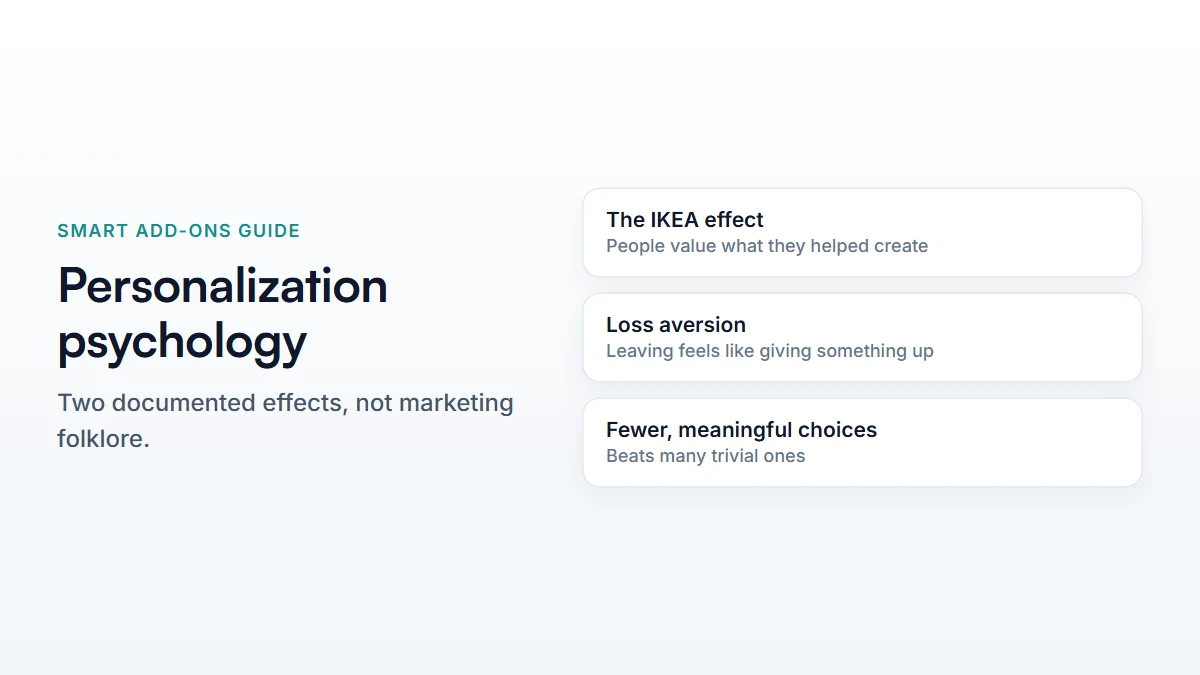
Two well-documented effects do most of the work: the IKEA effect, where people value something more highly because they had a hand in creating it, and loss aversion, where a shopper who has already configured a product feels they'd be giving something up by walking away from it. Neither is unique to e-commerce — they're general findings about how people value things they helped shape.
Personalization ecommerce psychology explains why “people will pay more for something they helped make” is more than a marketing slogan, but it’s a real, studied effect with a name — behavioral economists call it the IKEA effect, after research showing people valued furniture they assembled themselves more highly than identical pre-assembled furniture. Understanding personalization ecommerce psychology, and the two or three effects doing most of the work, changes how you’d design an add-on group compared to just guessing.
Personalization ecommerce psychology: the IKEA effect
The original research, by Michael Norton, Daniel Mochon and Dan Ariely, had participants assemble IKEA furniture, fold origami, or build with LEGO, then bid on their own creations alongside identical ones made by someone else. People consistently valued their own work more — not because it was objectively better, but because they’d put effort into it.
Choosing a fabric, engraving a name, or picking a combination of options is a smaller act of creation than assembling furniture, but the underlying psychology is the same direction: a shopper who spent two minutes configuring a product has a small stake in it that a shopper who clicked “buy now” on a fixed listing doesn’t.
Loss aversion: walking away starts to feel like giving something up
Once a shopper has built something specific — their name on it, their chosen colour, their exact combination — abandoning the cart stops being “I decided not to buy a mug” and starts feeling closer to “I’m giving up the mug I made.” Loss aversion, the well-established finding that losses are felt more strongly than equivalent gains, means that framing makes leaving marginally harder than it would be for an identical but unconfigured product.
What this means for how you design a group
If effort and ownership are what create the value, the practical implications point in a specific direction — mostly the opposite of “add as many options as possible”:
- A few meaningful choices beat many trivial ones. Deciding on a name, a colour and a size feels like creating something; deciding on eleven checkbox toggles feels like filling in a form. The IKEA effect comes from meaningful effort, not from effort alone.
- Show the result of each choice as it’s made. A live price preview — or better, a visual preview where the field type allows it — makes the act of creating something feel real rather than abstract, which is what the effect actually depends on.
- Let a shopper see their own choice reflected back. A cart line or order confirmation that clearly shows “Engraved: Sarah” rather than a generic product name reinforces that the shopper made this, not just bought it.
- Don’t ask for effort with no payoff. A required field that doesn’t visibly change anything — no price update, no visual difference — asks for the cost of configuration without the psychological benefit. See the required fields guide for when a field should actually be mandatory.
The limit of these effects
Neither effect is unlimited, and both can reverse. Too many decisions produces decision fatigue rather than ownership — see the conditional fields guide for keeping a configuration process from becoming a burden instead of an experience. And an effect grounded in genuine effort and ownership doesn’t transfer to manufactured pressure; conflating the two is how a legitimate psychological effect turns into something that reads as manipulative and erodes trust instead of building it.
Common questions
Does personalization ecommerce psychology justify a higher price?
It explains why shoppers are willing to pay more, which is different from justifying any specific markup. Price customization from your actual costs and market position, not from an assumption that psychology alone lets you charge whatever you like.
Is the IKEA effect the same as the psychology of choice generally?
They’re related but distinct. The IKEA effect is specifically about valuing something more because of the effort put into creating it. General choice psychology covers separate territory, like how too many options can reduce satisfaction with whatever’s eventually chosen — which is part of why fewer, meaningful options tend to work better than many trivial ones.
For the business case this psychology supports, see the competitive advantage guide, and Norton, Mochon and Ariely’s original paper, “The IKEA Effect” (opens in new tab), for the research itself.


Comments